
Disclaimer: This article is based on public sources from Google and EU legislation. We're not tax advisors. Talk to your accountant or tax advisor before applying anything you read here.
It's one of the few topics almost no Greek ad agency talks about — and at the same time one of the most common questions new clients bring up when they start seeing invoices from Google Ireland and Meta Ireland.
The issue: invoices show no VAT. This sometimes confuses accounting offices that don't work with digital advertising regularly, and we've seen businesses make wrong entries, fail to recognize the expense as deductible, or worse — pay 24% VAT they didn't need to.
Let's go through it as it is.
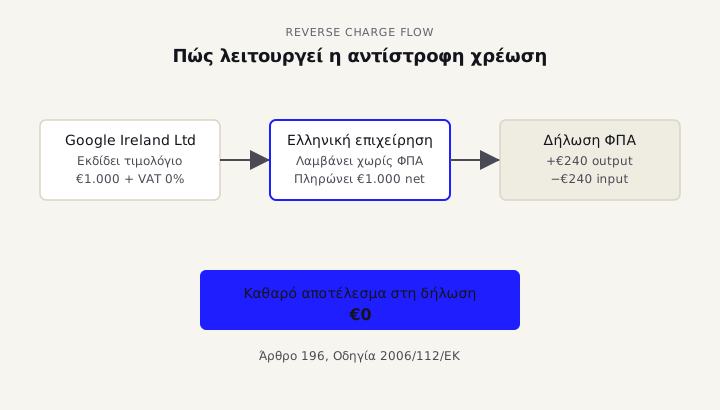
What reverse charge means
When a Greek business buys advertising services from Google or Meta, the invoice comes from:
- Google Ireland Ltd (Dublin, Ireland)
- Meta Platforms Ireland Limited (Dublin, Ireland)
These are EU-based companies providing services to another EU country (Greece). In this case, the reverse charge mechanism applies under Article 196 of EU Council Directive 2006/112/EC.
In practical terms this means:
- The invoice is issued without VAT (net amount)
- Responsibility for accounting for VAT shifts to the recipient (your Greek business)
- On your VAT return, you declare both the calculated VAT as output VAT and as input VAT — net effect is zero, provided VAT is deductible
Source: Google Ad Manager — Contracting entity is Google Ireland and Greek VAT regulations — Marosa.
A practical example
Say your Greek business spends €1,000 on Google Ads in November. The invoice you get from Google Ireland says €1,000 and "VAT 0%" or "Reverse charge — VAT to be accounted for by the recipient".
On your VAT return, your accountant will do this:
| VAT return field | Amount |
|---|---|
| Net foreign purchases (reverse charge) | €1,000 |
| Calculated 24% output VAT | +€240 |
| Deductible 24% input VAT | −€240 |
| Net effect on the return | €0 |
That's the "nice" part: if your business is VAT-registered, you essentially pay nothing extra. The reverse charge cancels out.
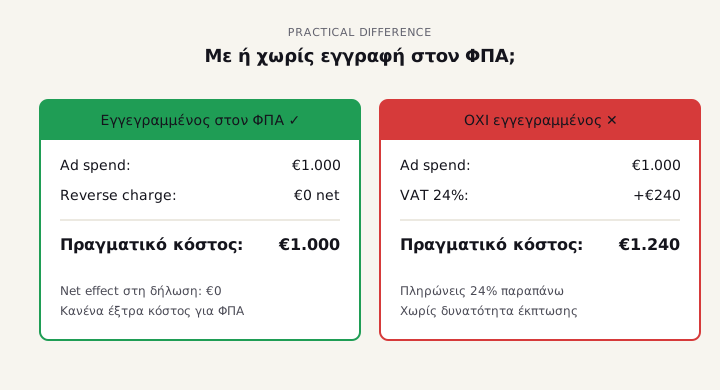
What changes if you're not VAT-registered
This is the bit most people overlook — and it can cost you more than you'd think.
If your business is not VAT-registered (very small business below thresholds, freelancer in some categories, etc.), the reverse charge doesn't work the way it does above. In this case you owe the 24% VAT to the state, with no ability to deduct it.
So €1,000 in Google Ads actually costs you €1,240 pre-tax.
Source: Greek VAT Guide 2025 — Taxually.
This makes a real difference to your break-even ROAS. If your ad spend is €5,000/month and you're not VAT-registered, your real cost is €6,200/month — meaning target ROAS needs to climb accordingly.
If this is your situation and you're running serious ad budgets, it's worth talking to your accountant about VAT registration — purely for the ads.
Practical steps to get this right
1. Provide the correct VAT number to Google Ads / Meta
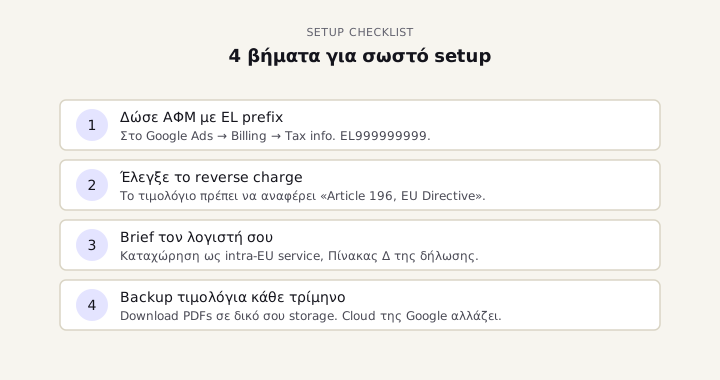
Connect your Greek VAT number (ΑΦΜ) in the format Google expects. In Google Ads:
- Billing → Settings → Payments profile
- Tax info: select Greece-based business
- Provide VAT number with the
ELprefix (e.g.EL999999999)
Same thing in Meta Business Manager:
- Business Settings → Business Info
- Tax ID: VAT number with
ELprefix
If you don't provide a VAT number, Google will charge you 24% Irish VAT until you prove you're a business. You'll get it back, but it's a headache you don't need.
2. Verify invoices reference reverse charge
When Google Ireland invoices arrive, make sure they include the phrase:
"Services provided are subject to the reverse charge mechanism per Article 196 of Council Directive 2006/112/EC"
If it's missing, ask Google support to send you an updated VAT invoice. Sometimes there's a caching issue with early invoices.
3. Brief your accountant on the right categorization
Google Ads and Meta Ads expenses are categorized as: - Intra-EU services - Subject to reverse charge - Logged in the Table D of the VAT return (foreign supplies)
If your accountant treats them as plain domestic expenses, that's wrong.
4. Save your invoices
Google and Meta invoices live in their cloud — and theoretically you can download them anytime. In practice though, Google has deletion policies and sometimes old invoices disappear after a few years. Download PDFs to your own storage every quarter.
In Google Ads: Billing → Documents → Download. In Meta: Billing → Transactions → Download invoice.
Other platforms
The same principles apply to any ad platform headquartered in another EU country: TikTok Ads (Ireland-based for Europe), LinkedIn Ads (Ireland), Pinterest Ads (Ireland), X/Twitter Ads (Ireland).
Things differ for: - US-based platforms (some direct contracts with US entities): non-EU services, different tax treatment. The above does NOT apply. Talk to your accountant. - Non-EU platforms like Reddit Ads (if contracted via US entity): different rules.
In practice, for 95% of Greek SMBs running Google + Meta, the standard EU reverse charge model applies.
Common mistakes we see
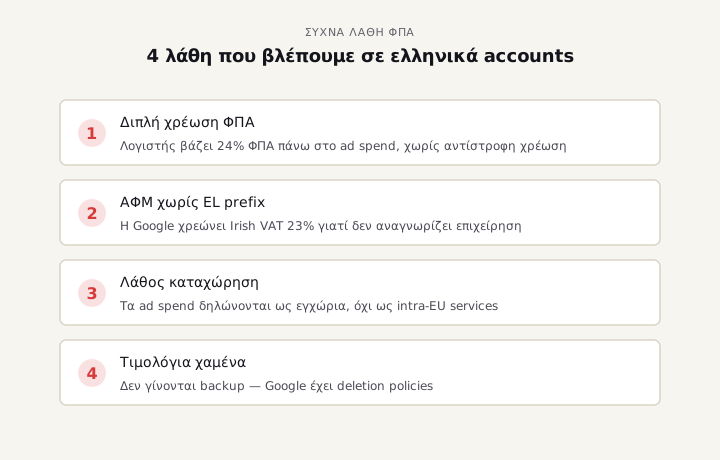
From quite a few audits of Greek accounts:
-
Accountant adds 24% VAT on top of ad spend as an "expense" without applying reverse charge. Result: client pays double VAT.
-
No VAT number given to Google Ads, so Google charges Irish VAT. The amount goes into expenses without anyone realizing the VAT could have been eliminated.
-
Not logged as intra-EU service on the VAT return. AADE (Greek tax authority) may ask for explanations during an audit.
-
No invoices kept — many assume bank statements are enough. In a tax audit, the actual PDFs are required.
Conclusion
In most cases:
- Greek business VAT-registered: reverse charge, net effect on return €0, no real burden beyond the actual ad spend.
- Greek business not VAT-registered: full VAT (24% or local rate) without deduction.
To avoid leaving money on the table or getting tangled in tax issues:
- Provide your VAT number to all ad platforms (with
ELprefix) - Make sure your accountant understands reverse charge
- Back up invoices quarterly
- If your ad spend exceeds €5,000/month and you're not VAT-registered, it's worth investigating
Not the sexiest part of performance marketing, but it's the part that can cost you 24% more for the same ad spend if you don't pay attention.
If you're not sure how it applies to your specific case, ask your accountant — and if you'd like us to take a look at your campaign numbers together, book a free audit.
Sources
- Google Ad Manager — Contracting entity is Google Ireland (official)
- Google AdSense — Contracting entity is Google Ireland (official)
- Greek VAT Guide 2025 — Taxually
- Greek VAT regulations — Marosa
- Council Directive 2006/112/EC, Article 196 (official EU)
- Is There VAT on Google Ads — Elver E-commerce Accountants