
In 2018, if you'd asked a performance marketer what mattered most in Meta ads, the answer would be audience targeting. Layered interests, 1% lookalikes, custom audiences from CRM, retargeting funnels.
In 2026, if you ask, the answer is one thing: creative.
According to the AppsFlyer 2025 report, 70-80% of Meta ad performance now comes from creative quality — not targeting, budget or bid strategy. The reason? Advantage+ campaigns and AI-driven optimization have "stolen" audience targeting from your hands. Your job is to feed the algorithm with lots of good creatives.
But what does "good creative" mean in 2026? Not what you think.
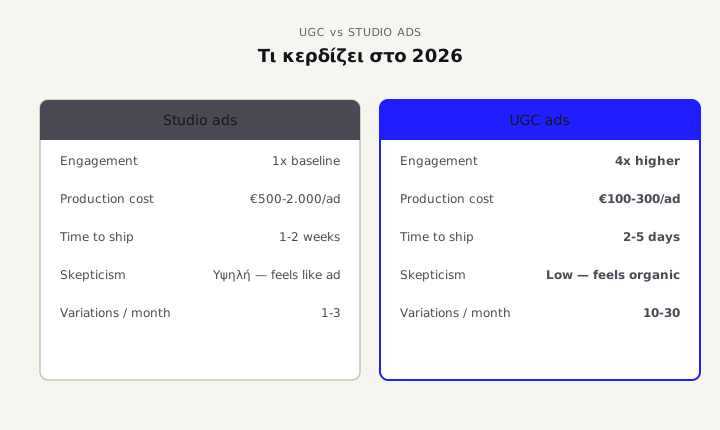
Studio ads are dying. UGC is winning.
There's a clear divide. On one side: brands with photographers, lighting setups, post-production, models, polished branded content. On the other: brands that hand the product to a creator/customer, who shoots vertical video on their phone in 5 minutes.
UGC wins consistently.
Brands that stopped polished studio ads and switched to UGC report (Cutting Edge Digital case study) results like 300+ leads in the first month on €600 budget — after switching to "problem-solution UGC" instead of brand-first lifestyle shots.
Why UGC works
- Native feeling: looks like organic content the user is scrolling through. Their brain doesn't go on the defensive ("ad detected").
- Built-in social proof: real person = real experience. You don't need a testimonial section anymore — the creative IS the testimonial.
- Lower production cost = more variations: you can produce 10 UGC creatives a week. Studio shoots? 1 a month.
- Cuts through skepticism: Gen Z and younger millennials have developed an allergy to commercial content. UGC reaction: "She seems normal, let me see what she says".
According to Straight North research, UGC-style ads see 4x higher engagement than traditional studio shots.
The framework that works: Hook → Problem → Solution → Product Proof → CTA
It's not just "shoot a video". There's a structure that leaks out from high-performing UGC ads:
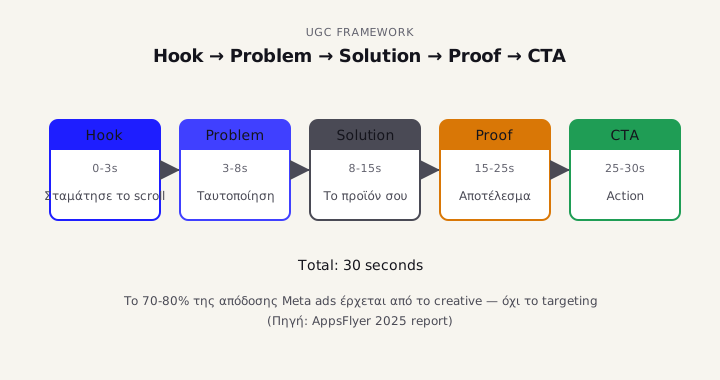
Hook (first 3 seconds)
The most important part. If you don't hold the user in the first 3 seconds, the ad is dead.
Hooks that work: - "I was skeptical about [product] until..." - "I can't believe they hid this from me for so long" - "This is the product that changed my [problem]" - "Stop scrolling — this actually works" - Pattern interrupt: start with unexpected visual or sound
Avoid: "Hi, my name is X" (boring), "Check out this amazing product" (sales-y), brand logo in first 3 sec (kills the hook).
Problem (seconds 3-8)
Identification. What problem does the viewer have that your product solves?
- "I tried 10 different supplements and nothing worked..."
- "Always struggled with [specific issue]..."
- "I've wasted so much money on [product category]..."
Practical rule: the problem must resonate. If the viewer doesn't recognize themselves here, they scroll.
Solution (seconds 8-15)
The product introduction. But not a feature dump. Show how you use the product in daily life.
- "Then I found [product]..."
- "I started taking this every morning..."
- Show product in action — not a photo on the table.
Product Proof (seconds 15-25)
The critical part that separates winners. Show results.
- Before/after (careful with Meta policies in beauty/health)
- Specific timeframe: "After 2 weeks I noticed..."
- Comparison: "I tried 5 others and this is..."
- Unboxing reaction
- Testimonial overlay from a review
CTA (seconds 25-30)
Action call, clean and direct.
- "Shop now and use code GREEK20 for 20% off"
- "Link in bio" doesn't work in Meta ads — use the CTA button
- Limited time pressure: "Only 50 left in stock", "Sale ends Sunday"
- Risk reversal: "Money-back if you don't love it"
Aspect ratio and placement strategy
The 4:5 vertical format wins.
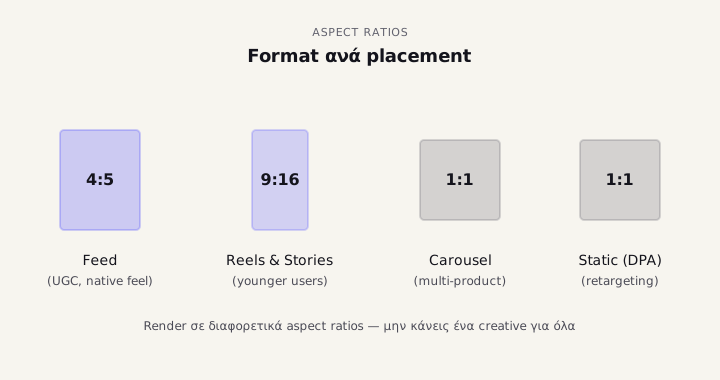 Billo internal research shows that 4:5 vertical delivers the best Feed performance — combining bigger screen real estate without looking like a "cut" Story.
| Format | Best for | Aspect ratio |
|---|---|---|
| Feed (organic feel) | Cold prospecting, UGC | 4:5 vertical |
| Reels & Stories | Younger audience, fast attention | 9:16 vertical |
| Carousel | Multi-product, education | 1:1 square |
| Static image (catalog) | Retargeting, DPA | 1:1 square |
Pro tip: don't use one creative for all placements. Render in different aspect ratios so text and subject don't get cut off.
Format mix that works
From real-world Advantage+ campaigns (Adligator framework 2026):
- 40% single images
- 30% short videos (6-15 seconds)
- 20% carousels
- 10% collection ads
This isn't a rule — it's a starting point. From there, scale what works for your specific brand.
Frequency: when a creative burns out
Frequency = how many times a user has seen the same ad.
| Audience | Healthy frequency | Warning |
|---|---|---|
| Cold prospecting | 1.0 - 2.0 | 2.5+ |
| Mid-funnel | 1.8 - 3.0 | 3.5+ |
| Retargeting | 3.0 - 5.0 | 6.0+ |
When you exceed the healthy zone, don't expand to a new audience first. Refresh creatives first. New audience with old creative = same problem in a different audience.
Creative refresh cadence
Reliable rule: new creatives every 2-3 weeks.
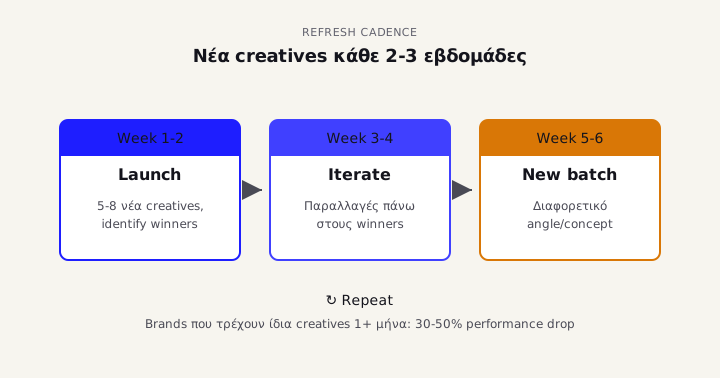
Brands running the same creatives for 1+ months see performance degradation of 30-50%. Algorithm + audience fatigue = killer combo.
Practical schedule for a typical e-commerce: - Week 1-2: Launch 5-8 new creatives, identify winners - Week 3-4: Iterate on the winners (variations of hooks, CTAs) - Week 5-6: New batch of 5-8 creatives — different angle/concept - Repeat
Common mistakes we see
From audits of Greek e-shops:
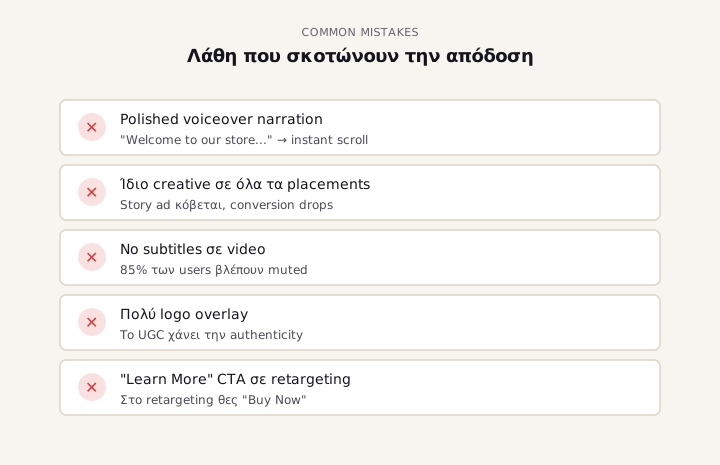
- Polished video with voiceover narrator saying "Welcome to our store" — instant scroll. Switch to UGC.
- Same creative across all placements without rendering for 9:16 or 4:5. The Story ad looks cropped, conversion drops.
- No subtitles on video ads. 85% of Meta users watch videos with audio muted. Subtitles = mandatory.
- Too much logo/branding overlay. UGC loses its authenticity.
- CTA "Learn More" on retargeting. On retargeting you want "Buy Now", "Shop Now". Not education — action.
What this means in practice for Greek SMBs
The Greek market has a peculiarity: it ignores the UGC trend compared to US/UK markets. 80% of Greek e-shop ads we see are still studio shots or product photos on white backgrounds.
This is an opportunity. If you're among the first Greek brands to roll out a serious UGC strategy, you have an advantage that competitors will struggle to copy.
How to start: 1. Give product to 5-10 customers, ask for video review (€50 gift card incentive) 2. Use platforms like Billo, Insense, or simply Instagram DMs to creators (€100-300/video) 3. Build a content library of 30-50 UGC clips 4. Test through Advantage+ Shopping (if you meet the criteria — see the related article)
Conclusion
In 2026 the Meta advertising game has changed. Audience targeting is a commodity (AI does almost all the work). Bid strategy is a commodity (Smart Bidding is default).
What remains differentiating: creative.
Brands that get this invest in: - UGC pipeline (creators, customers, employees) - Format variety (videos, statics, carousels) - Native production (not studio polish) - Constant refresh (every 2-3 weeks)
Brands that don't get it — see performance drop and blame "competition" or "iOS 14".
If today you're running the same 5 creatives for 3 months and ROAS is dropping — it's not "the market". It's the creative. Book a free audit and we'll show you exactly where your performance is leaking.
Sources
- Meta Ads Best Practices: What Actually Works in 2025 — Billo
- Meta Ads Creative Best Practices for Higher Conversions — Straight North
- The Complete Guide to UGC Video Ads — Influencer Marketing Hub
- Meta Ads Best Practices 2026 — OptiFOX Media
- The Ultimate 2025 Guide to Meta Ads Creative — Jason Harlton Marketing
- Meta Ad Creatives for E-commerce — Cutting Edge Digital Marketing