
Performance Max can be a serious driver of e-commerce growth. It can also turn into a black box that quietly burns budget without giving you a clear read on what's actually working.
Plenty of e-shops look at the ROAS reported inside Google Ads and assume PMax is performing. But once you cross-reference that against real profitability, new-customer acquisition, branded traffic and product margins, the picture often changes.
The issue isn't that Performance Max is good or bad. It's that it's frequently set up without a clear strategy, without a clean feed, without proper tracking, and without anyone really controlling where the budget is going.
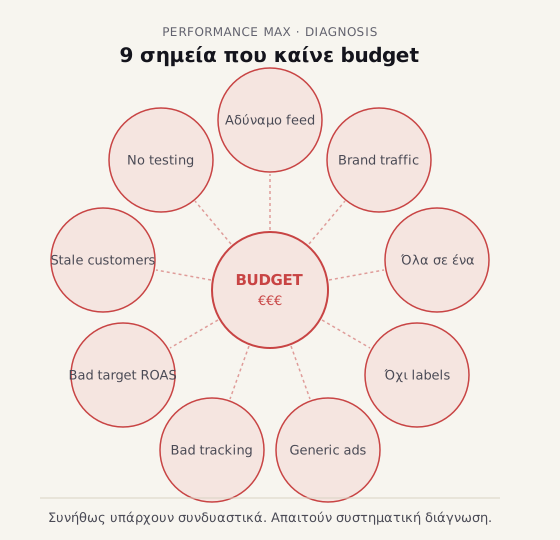
Want to know whether your PMax is burning budget or driving real profit? At Qutik we evaluate Performance Max beyond just ROAS — we look at feed quality, branded traffic, margins, tracking and actual blended profitability. Book a free Google Ads audit and find out what's really happening in the account.
1. The product feed is weak
Performance Max for e-commerce leans heavily on the product feed.
If product titles are thin, attributes are missing, categories are wrong and there are no custom labels, Google has fewer good signals to work out where to show your products.
A feed with titles like "Maria Dress" doesn't help anyone. A better title describes product type, gender, colour, material, use case or a key feature.
The feed isn't a product list. It's SEO for Google Shopping.
2. PMax is eating your branded traffic
A PMax campaign can show high ROAS simply because it's catching users who were already searching for your brand.
That isn't necessarily bad. But if a meaningful share of the performance comes from branded demand, the ROAS number is inflated.
You need to know whether you're paying for users who would have come anyway via organic, direct or brand search. Read the deep-dive on PMax and branded searches.
3. All products in the same campaign
One of the most common mistakes is dumping every product into a single PMax campaign with no segmentation.
Not all products have the same margin, the same conversion rate, the same stock availability, or the same commercial value.
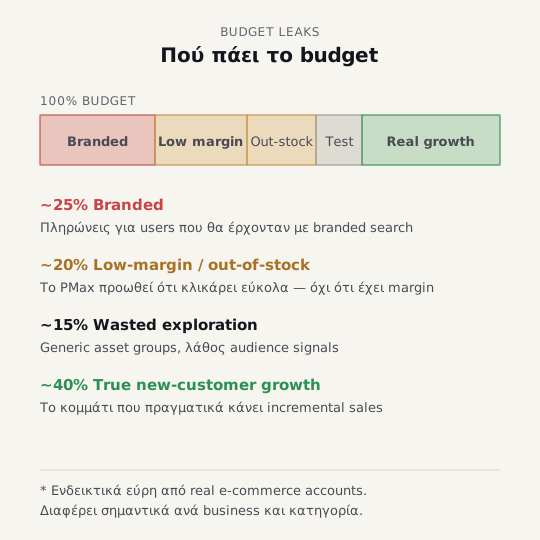
If you mix bestsellers, low-margin SKUs, out-of-season items and clearance stock, Google can push budget toward whatever is easiest to get clicks on — not toward whatever is actually profitable for you.
4. No custom labels
Custom labels are one of the most useful tools in Google Shopping / PMax.
You can segment products by:
- margin,
- bestsellers,
- seasonality,
- price range,
- stock status,
- promo status,
- new arrivals,
- clearance,
- target ROAS.
Without labels, the strategy you can apply is severely limited.
5. Asset groups are generic
A lot of asset groups are just stuffed with generic headlines and a few stock images.
PMax needs a clear thematic structure. If you sell different product categories, they shouldn't all share the same message.
One asset group for shoes, one for dresses, one for professional equipment, one for a seasonal promo.
If the assets don't match the products, you lose relevance.
6. Conversion tracking is wrong
If the Purchase event is wrong, PMax learns from bad data.
You need to verify:
- that you're measuring real purchases,
- that revenue is being passed correctly,
- that there are no duplicate conversions,
- that the primary conversion action is the right one,
- that enhanced conversions are active,
- that the data reconciles with Shopify / WooCommerce.
PMax is only as good as the data you feed it. Detailed walkthrough on Google Ads conversion tracking on WooCommerce.
7. Target ROAS is wrong
Set a target ROAS that's too tight from day one and you'll choke the campaign.
Set it too loose and you'll burn money on traffic that isn't profitable.
Target ROAS needs to be based on the real break-even ROAS of your business — not on a wish. If you don't know your margins, you can't set a meaningful target.
8. You're not looking at new-customer acquisition
PMax can show a strong ROAS simply because it's catching returning customers or branded demand.
If your real goal is growth, you need to know how many genuinely new customers are coming through.
Otherwise you're paying for existing demand and calling it scaling.
9. There's no clear testing plan
PMax isn't a "set it and forget it" product.
It needs ongoing testing across:
- feed titles,
- custom labels,
- campaign segmentation,
- asset groups,
- target ROAS,
- product exclusions,
- audience signals,
- landing pages,
- budget allocation.
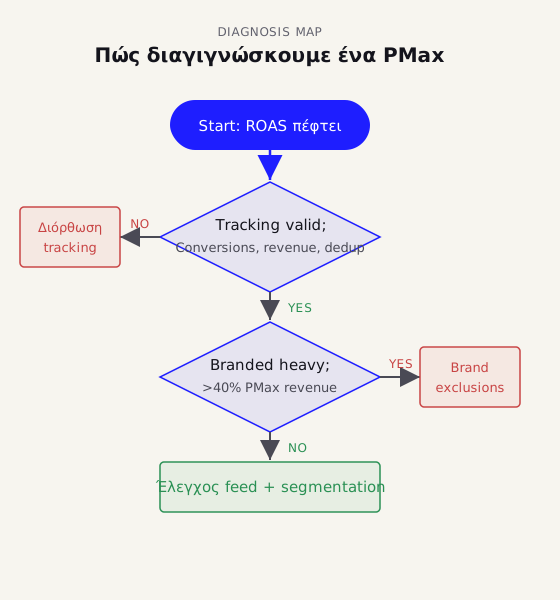
Without a plan, you're just hoping the algorithm will solve business problems for you. If you want the full diagnostic flow in one diagram:
Conclusion
Performance Max can deliver, but it isn't a magic button.
If the feed is weak, the tracking is wrong, the products are mixed together and the ROAS is inflated by branded traffic, PMax can quietly burn budget without producing real profit.
The right approach is diagnostic: feed, tracking, segmentation, branded contribution, asset quality and profitability — all reviewed deliberately.
FAQ
Why isn't Performance Max delivering?
The most common causes are a weak product feed, broken tracking, branded traffic inflating ROAS, generic asset groups, the wrong target ROAS, or poor product segmentation.
Is Performance Max good for e-shops?
Yes — when there's a solid feed, clean tracking, proper campaign structure and a clear profitability target. Without those, it's a black box.
Why does PMax show good ROAS but no real profit?
It can be measuring branded or returning demand, pushing low-margin products, capturing revenue with broken tracking, or operating against a break-even ROAS that's higher than you think.
Should I put all my products in one PMax campaign?
Not always. You usually need segmentation by margin, category, bestsellers, stock, seasonality or target ROAS.
What should I check first in a PMax campaign?
Start with conversion tracking, product feed, branded contribution, product segmentation, asset groups, and your real break-even ROAS.